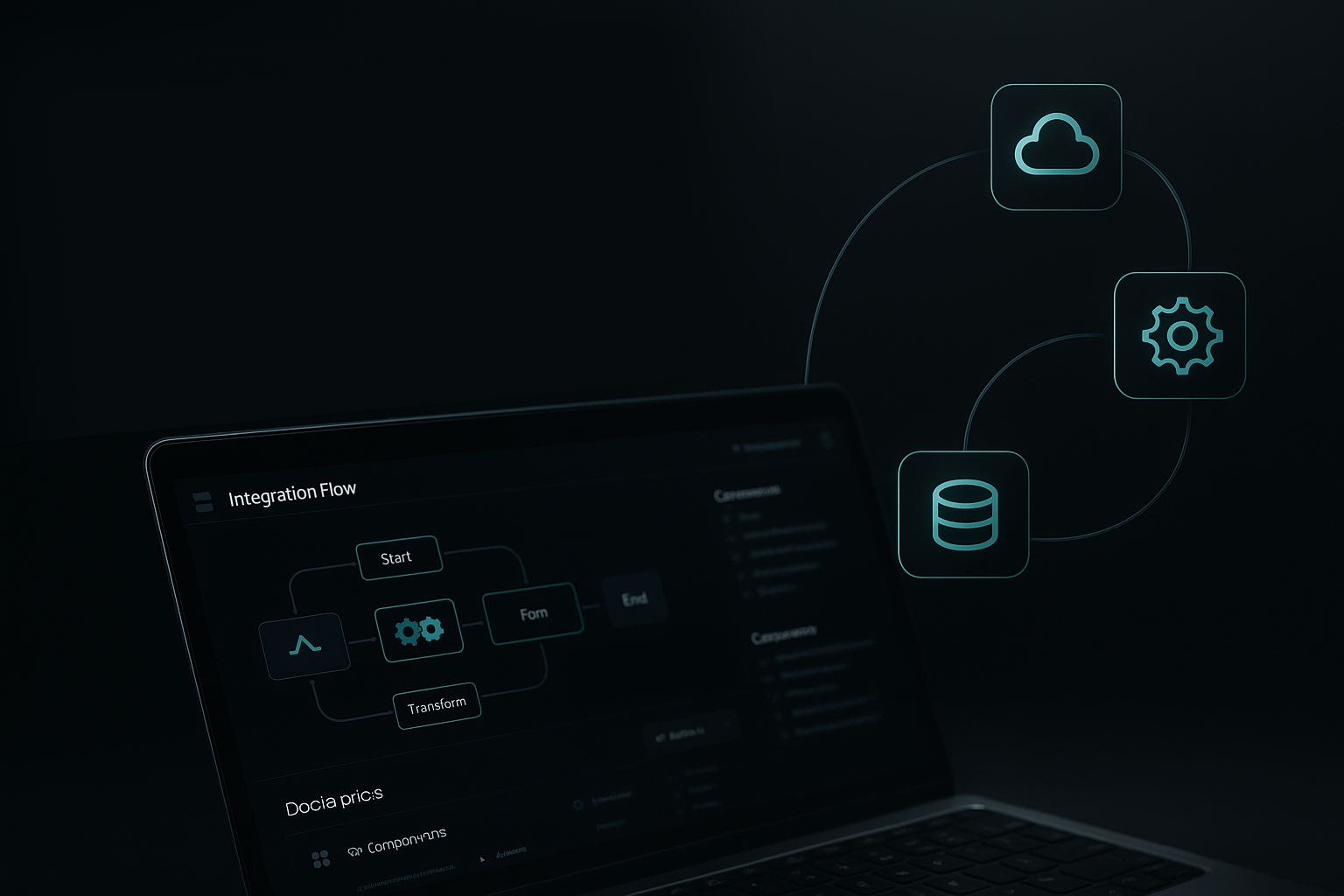
How do you build a product integration that works “out of the box” yet offers enough flexibility for clients with more advanced requirements? The brief was clear: create an integration solution that:
- requires minimal intervention during deployment,
- follows the industry's best practices,
- lets clients customize it without building from scratch,
- scales without increasing support demands.
Customers of the client's SaaS application faced complex and inconsistent integration with their internal systems. Typical obstacles included:
A high barrier to entry– integration required custom development or help from the IT department.
Slow deployment– every new instance required manual configuration.
Lack of flexibility – there was no way to tailor the integration to a company's specific needs.
Limited monitoring – without robust error reporting, problems were discovered late.
Get in touch and together we'll find a way to speed up your processes with automation and smart integration.
Book a free consultationWe designed a fully modular integration product made of reusable components. The solution was built on the Integray and Boomi platforms, which allow a high number of integration instances to run efficiently with low maintenance.
Basic integration starts immediately after the access details (endpoints, credentials) are set. More advanced customers can map data fields, adjust transformation logic and choose how errors are reported.
A built-in part of the product is an error monitoring and reporting system – by email as standard, but after customization also via tickets in ITSM tools or by saving to a custom database.
A big advantage of the solution is that we approached the integration as a standalone product that evolves and scales in parallel with the application itself.

For basic scenarios, the integration can be deployed within minutes with no development needed.

The product can serve hundreds of clients without increasing support demands.

A short path to a working solution increases client satisfaction and helps speed up onboarding.
Company ID: 22417079
instantIT s.r.o.
Rybná 716/24, Staré Město, 110 00 Prague 1, Czech Republic